Thursday, May 17, 2012


Tuesday, May 15, 2012
University of Birmingham Postgraduate Conference Papers
The postgraduate papers have now been publicized for the University of Birmingham Postgraduate Conference on 6 June.


Wednesday, May 2, 2012
The Great Isaiah Scroll and Its Damaged Exemplar
In DJD 32, Ulrich and Flint make the case that the Great Isaiah Scroll does not reflect a later stage of development than the MT (contra Kutscher), but instead often reflects an earlier stage of development to which the MT adds significant insertions. They cite seven examples of "Insertions in M highlighted by 1QIsa(a)": 2:9b-10; 34:17-35:2; 37:5-7; 38:20b-22; 40:7; 40:14b-16; 63aβ-bα. In reading the Isaiah scroll recently, I believe I have noticed a pattern which would undermine the major pillars of their thesis.
Preliminarily, it should be admitted that it is quite possible that the Isaiah scroll preserves earlier, pre-expanded texts. 40:7 may be an example, as the original scribe omitted the verse entirely. The Old Greek also omits this verse. The verse is redundant with v. 8. It also disrupts the connection between vv. 6 and 8. Furthermore, the way v. 7 explicitly identifies the referents in the metaphor is characteristic of explanatory glosses. So v. 7 may be a late expansion in the MT. On the other hand, it may be a simple case of haplography in the Greek and Isaiah scroll.
That said, I have noticed a pattern, which may alternatively explain four (34:17-35:2; 37:5-7; 38:20b-22; and 40:14b-16) of Ulrich's and Flint's seven examples. First, none of these can be explained by homoioteleuton. Second, each of these verses are secondarily inserted into the manuscript, bringing the text into alignment with the MT. Third, the original scribe intentionally left one or more blank lines at each of these points, possibly indicating awareness of textual problems. And fourth, each of these four minuses occur at approximately the same location in their respective columns. Noting these patterns, I would like to propose an alternative explanation for these examples.
The four first-hand omissions in 1QIsa(a) at 34:17-35:2; 37:5-7; 38:20b-22; and 40:14b-16 do not reflect a pre-MT stage in the development of the text of Isaiah, but rather a damaged exemplar used by the original scribe of 1QIsa(a). Upon reaching the damaged edges, the scribe left blank spaces in his new copy to be filled in with the correct text from another manuscript at a later time and then continued with the first subsequent legible texts. It is unlikely that the original scribe would have known the expanded text of Isaiah well enough to note the absence of such innocuous additional texts and to note them while copying a non-expanded text (contra Ulrich and Flint). Rather, the consistent pattern of blank spaces and their consistent locations in the text indicate a defective exemplar, which the original scribe copied as best as he could, leaving blank lines for later insertion of the lacunae.
I have rearranged the columns in 1QIsa(a) from photographs on the Israel Museum website to approximate what this reconstructed exemplar must have looked like. The red base line indicates the bottom margin of the exemplar, and the blue boxes mark off the damaged portions of the text. This reconstruction can only be approximate, since 1QIsa(a)--and probably its exemplar--has uneven column widths, but it is sufficient to show that the physical reconstruction of the manuscript provides an obvious explanation for the minuses.
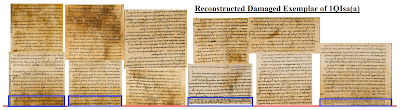
As we can see, all four of the major minuses occur at the bottom margin (potentially you could make the same case for the top margin) of the exemplar in close proximity. If the scroll had been damaged at that point, we would have a very straightforward explanation for how the verses could have been omitted in 1QIsa(a).
This proposal has several advantages of Ulrich's and Flint's proposal.
1) It does not require complex hypotheses about the scribe copying the non-expanded text while having in the back of his mind the expanded text, leaving room for (but not including) this alternative text. I would be interested to see if they can cite any other examples where this kind of procedure was followed. But I consider it quite unlikely that the scribe would have known both texts that well and followed such a scribal practice. My solution is much simpler and much more natural.
2) It explains why these "MT insertions" concentrate on such a small section of text, rather than being equally spread out across the entire book.
3) It explains why all of these were later inserted according to the MT, including one claimed by Ulrich and Flint to be in the original hand (37:5-7). Also interesting is the fact that (if their analysis is correct), the original scribe in 37:5-7 stopped mid-word, and then secondarily inserted the missing text! This would seem to be clear evidence for an exemplar whose bottom edge was defective.
For all of these reasons, my theory of a damaged exemplar for 1QIsa(a) seems to me to account for the evidence in a much simpler and more realistic manner than Ulrich's and Flint's proposal that it reflects a pre-MT stage of development. Careful attention to the physical characteristics of the manuscript and the practical mechanics of copying manuscripts has helped resolve several major textual problems. Without these central pillars, Ulrich's and Flint's theory is based on slender evidence indeed.
Update (10 April 2013): I have posted about the publication of my full DSD article on the Isaiah scroll here.
Preliminarily, it should be admitted that it is quite possible that the Isaiah scroll preserves earlier, pre-expanded texts. 40:7 may be an example, as the original scribe omitted the verse entirely. The Old Greek also omits this verse. The verse is redundant with v. 8. It also disrupts the connection between vv. 6 and 8. Furthermore, the way v. 7 explicitly identifies the referents in the metaphor is characteristic of explanatory glosses. So v. 7 may be a late expansion in the MT. On the other hand, it may be a simple case of haplography in the Greek and Isaiah scroll.
That said, I have noticed a pattern, which may alternatively explain four (34:17-35:2; 37:5-7; 38:20b-22; and 40:14b-16) of Ulrich's and Flint's seven examples. First, none of these can be explained by homoioteleuton. Second, each of these verses are secondarily inserted into the manuscript, bringing the text into alignment with the MT. Third, the original scribe intentionally left one or more blank lines at each of these points, possibly indicating awareness of textual problems. And fourth, each of these four minuses occur at approximately the same location in their respective columns. Noting these patterns, I would like to propose an alternative explanation for these examples.
The four first-hand omissions in 1QIsa(a) at 34:17-35:2; 37:5-7; 38:20b-22; and 40:14b-16 do not reflect a pre-MT stage in the development of the text of Isaiah, but rather a damaged exemplar used by the original scribe of 1QIsa(a). Upon reaching the damaged edges, the scribe left blank spaces in his new copy to be filled in with the correct text from another manuscript at a later time and then continued with the first subsequent legible texts. It is unlikely that the original scribe would have known the expanded text of Isaiah well enough to note the absence of such innocuous additional texts and to note them while copying a non-expanded text (contra Ulrich and Flint). Rather, the consistent pattern of blank spaces and their consistent locations in the text indicate a defective exemplar, which the original scribe copied as best as he could, leaving blank lines for later insertion of the lacunae.
I have rearranged the columns in 1QIsa(a) from photographs on the Israel Museum website to approximate what this reconstructed exemplar must have looked like. The red base line indicates the bottom margin of the exemplar, and the blue boxes mark off the damaged portions of the text. This reconstruction can only be approximate, since 1QIsa(a)--and probably its exemplar--has uneven column widths, but it is sufficient to show that the physical reconstruction of the manuscript provides an obvious explanation for the minuses.

As we can see, all four of the major minuses occur at the bottom margin (potentially you could make the same case for the top margin) of the exemplar in close proximity. If the scroll had been damaged at that point, we would have a very straightforward explanation for how the verses could have been omitted in 1QIsa(a).
This proposal has several advantages of Ulrich's and Flint's proposal.
1) It does not require complex hypotheses about the scribe copying the non-expanded text while having in the back of his mind the expanded text, leaving room for (but not including) this alternative text. I would be interested to see if they can cite any other examples where this kind of procedure was followed. But I consider it quite unlikely that the scribe would have known both texts that well and followed such a scribal practice. My solution is much simpler and much more natural.
2) It explains why these "MT insertions" concentrate on such a small section of text, rather than being equally spread out across the entire book.
3) It explains why all of these were later inserted according to the MT, including one claimed by Ulrich and Flint to be in the original hand (37:5-7). Also interesting is the fact that (if their analysis is correct), the original scribe in 37:5-7 stopped mid-word, and then secondarily inserted the missing text! This would seem to be clear evidence for an exemplar whose bottom edge was defective.
For all of these reasons, my theory of a damaged exemplar for 1QIsa(a) seems to me to account for the evidence in a much simpler and more realistic manner than Ulrich's and Flint's proposal that it reflects a pre-MT stage of development. Careful attention to the physical characteristics of the manuscript and the practical mechanics of copying manuscripts has helped resolve several major textual problems. Without these central pillars, Ulrich's and Flint's theory is based on slender evidence indeed.
Update (10 April 2013): I have posted about the publication of my full DSD article on the Isaiah scroll here.
Monday, April 30, 2012
Quantification of Variants in OTTC
Recent conversations in the comments of a past blog post prompted me to think a bit about the overall number of variants in the OT text. I also just finished an article by David J.A. Clines "What Remains of the Hebrew Bible? The Accuracy of the Text of the Hebrew Bible in the Light of the Qumran Samuel (4QSam(a))" in Studies on the Text and Versions of the Hebrew Bible in Honour of Robert Gordon, edited by Geoffrey Khan and Diana Lipton, 211-20 (Brill: Leiden, 2012). This article will serve as a good starting point for considering the quantification of variants in OTTC.
Right from the start, Clines takes on a very polemical and adversarial tone. With regard to Robert Gordon (for whom the volume was edited), Clines says, "If nothing else, this paper adds to the documentary evidence he will need if he is to refute the ideas (211)." Indeed, he retains the same tone throughout the article, eventually concluding that the Hebrew Bible is in a "state of radical uncertainty (219)," where every word is in doubt. In the end, however, I doubt Robert Gordon (or anyone else for that matter) will have much difficulty refuting Clines' ideas.
His basic argument is as follows. If we compare 2 Samuel 22 in the MT and 4QSam(a) and its parallel Psalm 18 we note that there are variants for one out of every two or three words. If we then extrapolate this ratio to the entire Hebrew Bible, we would have about 111,090 variants out of 305,500 words. Furthermore, McCarter accepts 6 variants to the MT as superior out of 66 words in 2 Sam 22, which would imply 27,700 places where the MT text is inferior in the whole Hebrew Bible. Since one out of two or three words on average would have had a variant at one time and we do not know which words had the variants, every single word is thrown into doubt, "as if we possessed an entirely uncertain text (218)." Yet he himself admits that we generally know the contents of the Hebrew Bible, even if not every detail (219).
There are many interesting things to note from his statistics, but also many problematic elements. He claims to have dealt with complicating factors in a previous paper (217), but as these pertain to fundamental logical and evidential flaws in his approach, he should have nuanced his current argument as well. Since he fails to do so, his chapter reads as little more than sweeping generalizations leading to unwarranted conclusions. A few points are important to keep in mind when encountering such claims.
1) Choice of Test Passage: Clines' choice of 2 Sam 22 and Psalm 18 does not appear to be random, but to have been purposely selected to bolster his argument. First, Samuel is well-known as being one of the most corrupt texts in the MT. Second, 2 Sam 22 and Psalm 18 are well-known for significant differences between these parallel passages. Indeed, looking at BHS, almost half the page for each page for 2 Sam 22 is devoted to variants, in contrast to the few lines characteristic of most other books. If you want to prove the text is disputed, base your statistics on one of the most disputed texts available! Studying other passages would have dramatically changed his results. If he had compared Isaiah 36-39 with the parallels in 2 Kings as I have recently been doing, he would have found a much more stable base text.
2) Redactional Differences in Parallels: Clines treats all differences between 2 Sam 22 and Psalm 18 as equivalent, when there is in fact good reason to believe that many of the differences arose from intentional redactional activity as the literary unit was transferred from one context to another. If this is the case, then these differences have no bearing on the accuracy of the transmission of the text of Samuel or Psalms. Parallels cannot be properly used without a nuanced appreciation of their individual contexts. By treating all of the variants in the same way, he has further increased his number of "variants."
3) Extrapolation of Statistics: Clines takes the ratios derived from his study of 2 Sam 22 and then extrapolates the data to see what a similar ratio would yield for the entire Hebrew Bible. This is problematic for two reasons. First, the mere fact that his numbers are actually extrapolations and not actual evidence makes them little more than hot air, especially since they come from such a small pool of texts. His statistics on 2 Sam 22 tell us nothing about the state of the text of the rest of the Hebrew Bible. Second, this extrapolation is misleading, since his pool of texts is non-representative. The books of the Hebrew Bible are very different in nature and preservation, and we cannot safely generalize about books other than those included in our study. His statistics on 2 Sam 22 tell us how many variants there are for 2 Sam 22, and nothing more. His results are significantly smaller when he looks at Isaiah, for instance.
4) Evaluation of Variants: While Clines thankfully does not include merely orthographic variants, he does include all variants without respect to their value or the characteristics of the witnesses which attest to them. This method is quite problematic. For instance, I have heard that the Samaritan Pentateuch has around 6000 variants from the MT. Many of these, however, are clearly secondary, and do not throw the text of the MT into doubt. In a sense, these variants are mostly irrelevant for the question of the preservation of the MT. Likewise, centuries of collations of medieval manuscripts and late translations have shown that variants can be multiplied ad absurdam without significantly altering our understanding of the text. Simple numbers, apart from detailed textual analysis, are meaningless at best and misleading at worst. To show corruption in the MT text, you have to demonstrate the secondary nature of its text, not simply state that there are variants.
5) Simple Mathematics: And of course, as with any statistical argument, we must be sensitive to the statistical methods employed. Clines counts pluses and minuses by word, rather than by variation units, for instance. You have to consider which base text he counts for his word numbers as well. I do not want to get into all the statistical details, but suffice it to say that these are something to be aware of.
6) Unwarranted Conclusions: And the final major point I would make is simply that the primary conclusion he draws is simply not warranted by his evidence. Depending on how you define a variant and how exhaustively you examine the manuscript evidence, I imagine you could probably claim to have found even more than 100,000 variants and speculate about far more. But this number would prove absolutely nothing. It is like Bart Ehrman's classic 400,000 variants in the NT statistic, which is designed more to wow uninformed audiences than to make a nuanced point about the preservation of the text. The simple reality is that the preservation of the OT is far more complex than any such simplistic arguments could possibly cover. Some texts are quite well preserved, while others are more problematic. Some variants to the MT are earlier, and some variants are later. The preservation of any given text must be studied in its own right by collating, sorting, and evaluating the extant evidence.
In contrast to Clines' extreme skepticism, I would point out the statements of Gene Ulrich (the general editor for the cave 4 Qumran manuscripts) to the effect that, "The base text of most books remained relatively stable... Clearly the books were copied with a care and fidelity that fills us with awe and admiration (DSS and the Origins of the Bible 109, 114)." According to Ulrich, though occasionally certain scribes made significant editorial revisions to biblical books, most of the text was accurately copied down from generation to generation. Unfortunately, because of the immensity and complexity of the evidence, we will never be able to quantify the variants in the OT text. But the preserved evidence by no means requires a radical pessimism about the text. It is not very often that you will hear scholars call their own positions "radical," but in Clines' case, he is clearly correct.
Right from the start, Clines takes on a very polemical and adversarial tone. With regard to Robert Gordon (for whom the volume was edited), Clines says, "If nothing else, this paper adds to the documentary evidence he will need if he is to refute the ideas (211)." Indeed, he retains the same tone throughout the article, eventually concluding that the Hebrew Bible is in a "state of radical uncertainty (219)," where every word is in doubt. In the end, however, I doubt Robert Gordon (or anyone else for that matter) will have much difficulty refuting Clines' ideas.
His basic argument is as follows. If we compare 2 Samuel 22 in the MT and 4QSam(a) and its parallel Psalm 18 we note that there are variants for one out of every two or three words. If we then extrapolate this ratio to the entire Hebrew Bible, we would have about 111,090 variants out of 305,500 words. Furthermore, McCarter accepts 6 variants to the MT as superior out of 66 words in 2 Sam 22, which would imply 27,700 places where the MT text is inferior in the whole Hebrew Bible. Since one out of two or three words on average would have had a variant at one time and we do not know which words had the variants, every single word is thrown into doubt, "as if we possessed an entirely uncertain text (218)." Yet he himself admits that we generally know the contents of the Hebrew Bible, even if not every detail (219).
There are many interesting things to note from his statistics, but also many problematic elements. He claims to have dealt with complicating factors in a previous paper (217), but as these pertain to fundamental logical and evidential flaws in his approach, he should have nuanced his current argument as well. Since he fails to do so, his chapter reads as little more than sweeping generalizations leading to unwarranted conclusions. A few points are important to keep in mind when encountering such claims.
1) Choice of Test Passage: Clines' choice of 2 Sam 22 and Psalm 18 does not appear to be random, but to have been purposely selected to bolster his argument. First, Samuel is well-known as being one of the most corrupt texts in the MT. Second, 2 Sam 22 and Psalm 18 are well-known for significant differences between these parallel passages. Indeed, looking at BHS, almost half the page for each page for 2 Sam 22 is devoted to variants, in contrast to the few lines characteristic of most other books. If you want to prove the text is disputed, base your statistics on one of the most disputed texts available! Studying other passages would have dramatically changed his results. If he had compared Isaiah 36-39 with the parallels in 2 Kings as I have recently been doing, he would have found a much more stable base text.
2) Redactional Differences in Parallels: Clines treats all differences between 2 Sam 22 and Psalm 18 as equivalent, when there is in fact good reason to believe that many of the differences arose from intentional redactional activity as the literary unit was transferred from one context to another. If this is the case, then these differences have no bearing on the accuracy of the transmission of the text of Samuel or Psalms. Parallels cannot be properly used without a nuanced appreciation of their individual contexts. By treating all of the variants in the same way, he has further increased his number of "variants."
3) Extrapolation of Statistics: Clines takes the ratios derived from his study of 2 Sam 22 and then extrapolates the data to see what a similar ratio would yield for the entire Hebrew Bible. This is problematic for two reasons. First, the mere fact that his numbers are actually extrapolations and not actual evidence makes them little more than hot air, especially since they come from such a small pool of texts. His statistics on 2 Sam 22 tell us nothing about the state of the text of the rest of the Hebrew Bible. Second, this extrapolation is misleading, since his pool of texts is non-representative. The books of the Hebrew Bible are very different in nature and preservation, and we cannot safely generalize about books other than those included in our study. His statistics on 2 Sam 22 tell us how many variants there are for 2 Sam 22, and nothing more. His results are significantly smaller when he looks at Isaiah, for instance.
4) Evaluation of Variants: While Clines thankfully does not include merely orthographic variants, he does include all variants without respect to their value or the characteristics of the witnesses which attest to them. This method is quite problematic. For instance, I have heard that the Samaritan Pentateuch has around 6000 variants from the MT. Many of these, however, are clearly secondary, and do not throw the text of the MT into doubt. In a sense, these variants are mostly irrelevant for the question of the preservation of the MT. Likewise, centuries of collations of medieval manuscripts and late translations have shown that variants can be multiplied ad absurdam without significantly altering our understanding of the text. Simple numbers, apart from detailed textual analysis, are meaningless at best and misleading at worst. To show corruption in the MT text, you have to demonstrate the secondary nature of its text, not simply state that there are variants.
5) Simple Mathematics: And of course, as with any statistical argument, we must be sensitive to the statistical methods employed. Clines counts pluses and minuses by word, rather than by variation units, for instance. You have to consider which base text he counts for his word numbers as well. I do not want to get into all the statistical details, but suffice it to say that these are something to be aware of.
6) Unwarranted Conclusions: And the final major point I would make is simply that the primary conclusion he draws is simply not warranted by his evidence. Depending on how you define a variant and how exhaustively you examine the manuscript evidence, I imagine you could probably claim to have found even more than 100,000 variants and speculate about far more. But this number would prove absolutely nothing. It is like Bart Ehrman's classic 400,000 variants in the NT statistic, which is designed more to wow uninformed audiences than to make a nuanced point about the preservation of the text. The simple reality is that the preservation of the OT is far more complex than any such simplistic arguments could possibly cover. Some texts are quite well preserved, while others are more problematic. Some variants to the MT are earlier, and some variants are later. The preservation of any given text must be studied in its own right by collating, sorting, and evaluating the extant evidence.
In contrast to Clines' extreme skepticism, I would point out the statements of Gene Ulrich (the general editor for the cave 4 Qumran manuscripts) to the effect that, "The base text of most books remained relatively stable... Clearly the books were copied with a care and fidelity that fills us with awe and admiration (DSS and the Origins of the Bible 109, 114)." According to Ulrich, though occasionally certain scribes made significant editorial revisions to biblical books, most of the text was accurately copied down from generation to generation. Unfortunately, because of the immensity and complexity of the evidence, we will never be able to quantify the variants in the OT text. But the preserved evidence by no means requires a radical pessimism about the text. It is not very often that you will hear scholars call their own positions "radical," but in Clines' case, he is clearly correct.
Sunday, April 29, 2012
Isaiah 39:1 || 2 Kings 20:12
Reading the Great Isaiah Scroll (1QIsa(a)) along with the MT of Isaiah 39:1 and the parallel passage in 2 Kings 20:12, I came across a particularly interesting variant.
MT(Isa) and 1QIsa(b)
וישמע כי חלה ויחזק
"And he (Merodach-Baladan) had heard that he (Hezekiah) had been sick and regained his strenght."
MT and LXX (Kgs)
כי שמע כי חלה חזקיהו
"Because he (Merodach-Baladan) had heard that Hezekiah had been sick."
1QIsa(a)
וישמע כיא חלה ויחיה
"And he (Merodach-Baladan) had heard that he (Hezekiah) had been sick and lived."

One medieval manuscript, one tradition of the Greek, and the Syriac (Kgs)
כי שמע כי חלה חזקיהו ויחי
"Because he (Merodach-Baladan) had heard that Hezekiah had been sick and lived."
First we notice the difference between וישמע "and he heard" and כי שמע "because he heard." Interestingly enough, 4QIsa(b) has כי שמע, as with the Kings witnesses. Either one of these texts has been corrupted by scribal errors, or else כי שמע could be a clarification of what was meant by וישמע. But the most interesting point is the complicated variant that comes next.
1QIsa(a)'s ויחיה "and lived" seems to be clarifying the somewhat more difficult ויחזק "and regained his strength" with the more usual expression. Since the first three letters of these words are identical and the former reading is more natural, it is not impossible that the scribe made this change unintentinoally, but it may also be an intentional change.
The next thing we note is that the verb ויחזק "and regained his strength" and the name חזקיהו "Hezekiah" (often spelled with a י at the beginning, such as יחזקיה) are very similar, so we clearly have an instance of simple scribal error. Which came first? I'm betting the somewhat awkward ויחזק was first, and that a scribe misread it as חזקיהו or יחזקיה. The opposite is less likely, since the scribe would have had to have created two new letters at the beginning to form a verb וי and the verb would have been much more difficult than the noun.
The additions to Kings took this corrupted text and conflated it with a text very similar to 1QIsa(a), giving a double reading.
Thus, I would construct the following localized stemma of variants:
ויחזק
/ \
חזקיהו ויחיה
\ /
חזקיהו ויחי
So we have here a clear example of corruption in parallel texts in the MT (viz. Kgs), a synonymous substitution, and a conflation of variants. Quite the interesting combination!
MT(Isa) and 1QIsa(b)
וישמע כי חלה ויחזק
"And he (Merodach-Baladan) had heard that he (Hezekiah) had been sick and regained his strenght."
MT and LXX (Kgs)
כי שמע כי חלה חזקיהו
"Because he (Merodach-Baladan) had heard that Hezekiah had been sick."
1QIsa(a)
וישמע כיא חלה ויחיה
"And he (Merodach-Baladan) had heard that he (Hezekiah) had been sick and lived."

One medieval manuscript, one tradition of the Greek, and the Syriac (Kgs)
כי שמע כי חלה חזקיהו ויחי
"Because he (Merodach-Baladan) had heard that Hezekiah had been sick and lived."
First we notice the difference between וישמע "and he heard" and כי שמע "because he heard." Interestingly enough, 4QIsa(b) has כי שמע, as with the Kings witnesses. Either one of these texts has been corrupted by scribal errors, or else כי שמע could be a clarification of what was meant by וישמע. But the most interesting point is the complicated variant that comes next.
1QIsa(a)'s ויחיה "and lived" seems to be clarifying the somewhat more difficult ויחזק "and regained his strength" with the more usual expression. Since the first three letters of these words are identical and the former reading is more natural, it is not impossible that the scribe made this change unintentinoally, but it may also be an intentional change.
The next thing we note is that the verb ויחזק "and regained his strength" and the name חזקיהו "Hezekiah" (often spelled with a י at the beginning, such as יחזקיה) are very similar, so we clearly have an instance of simple scribal error. Which came first? I'm betting the somewhat awkward ויחזק was first, and that a scribe misread it as חזקיהו or יחזקיה. The opposite is less likely, since the scribe would have had to have created two new letters at the beginning to form a verb וי and the verb would have been much more difficult than the noun.
The additions to Kings took this corrupted text and conflated it with a text very similar to 1QIsa(a), giving a double reading.
Thus, I would construct the following localized stemma of variants:
ויחזק
/ \
חזקיהו ויחיה
\ /
חזקיהו ויחי
So we have here a clear example of corruption in parallel texts in the MT (viz. Kgs), a synonymous substitution, and a conflation of variants. Quite the interesting combination!
Digitally Enhanced Images
Steve Caruso has an image on his blog that is quite astounding. Whom do you see?

If you see Albert Einstein, you are absolutely correct. Except of course that it is actually an image of Marilyn Monroe! Don't believe me? Step back a ways from your monitor!
The picture is actually a fuzzy picture of Monroe, but certain minor details have been enhanced in such a way as to correspond to Einstein's face. By "enhancing" the image, the artist has actually tricked our minds into seeing the wrong image... the one he created! What does this have to do with OTTC? Believe it or not, a lot, since almost all of the textual critic's resources are photographic!Chances to view the manuscripts themselves are quite rare for most of us common folk!
I recently read a chapter by Bruce Zuckerman demonstrating how similar principles can lead to misreading DSS evidence as well. Every photographic representation of a manuscript is an artist's interpretation of the manuscript. From simple issues such as lighting and angles to more complex processes of enhancing ink traces scholars think they see for the aid of readers, every single decision introduces an element of interpretation which has the potential to affect the way we see the evidence. If artists can make an entire human face appear out of nowhere, digital representations of scrolls fragments can quite easily create readings that simply aren't there! This does not mean that we throw out all images in despair, only that artists should clearly state their interpretive decisions up front and that we must use the images with appropriate caution.
If you see Albert Einstein, you are absolutely correct. Except of course that it is actually an image of Marilyn Monroe! Don't believe me? Step back a ways from your monitor!
The picture is actually a fuzzy picture of Monroe, but certain minor details have been enhanced in such a way as to correspond to Einstein's face. By "enhancing" the image, the artist has actually tricked our minds into seeing the wrong image... the one he created! What does this have to do with OTTC? Believe it or not, a lot, since almost all of the textual critic's resources are photographic!Chances to view the manuscripts themselves are quite rare for most of us common folk!
I recently read a chapter by Bruce Zuckerman demonstrating how similar principles can lead to misreading DSS evidence as well. Every photographic representation of a manuscript is an artist's interpretation of the manuscript. From simple issues such as lighting and angles to more complex processes of enhancing ink traces scholars think they see for the aid of readers, every single decision introduces an element of interpretation which has the potential to affect the way we see the evidence. If artists can make an entire human face appear out of nowhere, digital representations of scrolls fragments can quite easily create readings that simply aren't there! This does not mean that we throw out all images in despair, only that artists should clearly state their interpretive decisions up front and that we must use the images with appropriate caution.
Friday, April 20, 2012
Paleography and Second Hand Corrections
At the end of chapter 34 in the Great Isaiah Scroll, I came across a significant correction. The first hand omits the end of 34:17 - 35:2. A second corrector has gone back and corrected this omission by adding in the missing text.


These corrections offer good examples for paleographic study of the different hands in the manuscript. When I first began reading Hebrew manuscripts, I was often bewildered by paleographers' claims to be able to distinguish multiple hands within manuscripts and their corrections. The differences often seemed so small and the letter forms so inconsistent, that I found identifying different hands very difficult. I must admit, I am still far from expert in paleography, but I can pick up on much more now than when I first began. Reading through the Great Isaiah Scroll in particular, I have become intimately familiar with the original hand of the manuscript by sheer repetition. With this familiarity in the background, many of the differences in the corrections practically jump off the page now. And I'm not just talking about the size and color of the scripts. I think this would be a good point to show some of the distinguishing characteristics of the hands to show how such work is done.
* - Original Hand
1 - First Correction (34:17 - 35:2)
2 - Second Correction (37:5-7)
Aleph
 Both corrections show significant differences in the general form of the aleph. The left downstroke meets the diagonal almost at the far upper left corner, instead of the more normal location closer to the middle. The original hand also has more curve to it.
Heh
 The second correction is quite close to the original hand, but the first correction is clearly distinct. It is more boxy, the horizontal stroke meets close to the top of the rightmost vertical stroke, and the leftmost vertical stroke barely touches the horizontal.
Waw
 Once again, the second correction is much closer to the original hand than the first correction. The first has sharper angles and bends to the right (instead of the left) at the bottom.
Yodh
 As before, the second correction is much closer to the original hand than the first correction. The first correction does not have the distinct carrot shape of the other two, but is more of a closed wedge shape.
Final Peh
 Another example of how the first correction is clearly different from the main hand is his use of a special final form for the letter peh in the word אף. The main hand uses the same form as in the middle of words.
We could line up many such examples to show the precise differences between the different handwritings. These are merely a few letters as examples, but we can draw a few conclusions from them. The first correction is clearly done by a later scribe. The letter forms are quite drastically different from the original hand and exhibit later influences. These differences are so many and so striking that it is impossible to miss them, after you have been reading the Isaiah scroll for a while.
On the other hand, the second correction is written in a hand much more similar to the original hand. From these initial investigations, I suspect that it is a different scribe, due to slightly different letter forms. Nevertheless, because the two hands are so similar in many ways, we would have to look much more carefully to confirm this.
While this is very basic, I hope it helps clarify how scholars really can tell the difference between the handwritings of different scribes. Sometimes it is easy to tell, and other times it is more difficult. But it is always essential to understanding the history of the manuscript and its text.

A similar situation occurs in 37:5-7.

Interestingly, in both places, the original scribe left an unusual blank line. Perhaps he was aware of his omissions? Perhaps his exemplar was damaged at these points, given the physical proximity of the corrections?
* - Original Hand
1 - First Correction (34:17 - 35:2)
2 - Second Correction (37:5-7)
Aleph

Heh

Waw

Yodh

Final Peh

We could line up many such examples to show the precise differences between the different handwritings. These are merely a few letters as examples, but we can draw a few conclusions from them. The first correction is clearly done by a later scribe. The letter forms are quite drastically different from the original hand and exhibit later influences. These differences are so many and so striking that it is impossible to miss them, after you have been reading the Isaiah scroll for a while.
On the other hand, the second correction is written in a hand much more similar to the original hand. From these initial investigations, I suspect that it is a different scribe, due to slightly different letter forms. Nevertheless, because the two hands are so similar in many ways, we would have to look much more carefully to confirm this.
While this is very basic, I hope it helps clarify how scholars really can tell the difference between the handwritings of different scribes. Sometimes it is easy to tell, and other times it is more difficult. But it is always essential to understanding the history of the manuscript and its text.
Subscribe to:
Posts (Atom)